
As Indian organisations approach the May 2027 compliance timeline, under the Digital Personal Data Protection Act, 2023, and the Digital Personal Data Protection Rules, many teams ask, “Do we need separate programmes for PIMS, DPDPA, and GDPR, or can a single privacy framework address all three?”
This blog answers that question and explores how the three frameworks intersect and what practical steps organisations can take today to strengthen their PIMS posture, advance DPDP Act implementation, and support GDPR readiness, without significant additional effort or cost.
Understanding PIMS, DPDPA, and GDPR
ISO/IEC 27701 (PIMS), first published in August 2019 and revised in October 2025, provides an independent international standard for establishing, implementing, maintaining, and continually improving a Privacy Information Management System.
The DPDPA 2023 establishes a comprehensive framework for protecting personal data in India, with a focus on consent management, accountability, and transparency. This was followed by the notification of the DPDP Rules, 2025, which provides detailed operational guidance.
The General Data Protection Regulation (GDPR), implemented in May 2018, sets clear rules for how organisations must handle the personal data of individuals in the EU, including when processing occurs outside the EU.
While these frameworks overlap in several areas, their alignment is not always immediately obvious. This blog examines how they intersect and outlines how organisations can build a unified privacy programme that reduces duplication, streamlines effort, and ensures compliance with both national data protection rules and international data protection expectations.
PIMS, DPDPA, and GDPR: An Operational Overview
Below is a simplified operational view of how organisations typically engage with these frameworks.
| Framework | Core Purpose | Scope | Operational Focus | Enforcement |
| PIMS (ISO/IEC 27701) | Establishes a structured privacy management framework for personal data and Personally Identifiable Information (PII) | Organisation-wide personal data and PII processing; adoption of the standard is voluntary | • Privacy governance controls • Standardised workflows for personal data and PII handling • Data minimisation and purpose limitation alignment • Accountability and evidence management | Independent certification audits and external assurance |
| DPDPA (India) | Regulates lawful processing of digital personal data based on consent and accountability | Digital personal data processed in India, and certain processing outside India related to offering goods or services to individuals in India | • Consent artefacts and records • Consent withdrawal and propagation • Purpose-bound retention and data minimisation • Cross-border data transfers subject to government-notified restrictions and security safeguards | Data Protection Board of India; penalties of up to ₹250 crore under the DPDP Act |
| GDPR (EU) | Establishes rights for individuals and obligations for organisations in the processing of personal data | Personal data of individuals in the EU, including extra-territorial processing | • Privacy by design and by default • Data minimisation and purpose limitation • Cross-border data transfers and safeguards • Rights fulfilment mechanisms | EU Supervisory Authorities; fines of up to €20 million or 4% of global annual turnover |
PIMS, DPDPA, and GDPR share common privacy principles, such as lawful processing, consent or other lawful bases, purpose limitation, data minimisation, individual rights management, security safeguards, and breach notification readiness.
While DPDPA and GDPR impose legal obligations, PIMS provides a structured framework to support consistent implementation of these requirements across organisational processes.
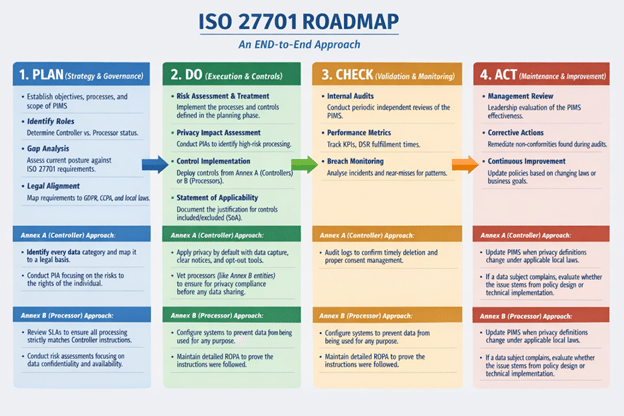
Anzen’s GRC consulting team helps organizations design and operate a unified privacy program. We bridge the gap between strategy and execution, ensuring PIMS, DPDPA, and/or GDPR are perfectly calibrated for your organisation, whether you’re focused on individual rights or prioritizing contractual security.
Five Quick Ways to Build One Unified Privacy Programme
- Define Purpose Boundaries
Link each dataset to a clearly defined purpose and retention requirement to prevent unauthorised or outdated processing and reinforce purpose limitation and data minimisation. - Build a Central Data Inventory
Maintain a single, centralised inventory that maps personal data across applications, infrastructures, APIs, and third parties, enabling accurate data mapping, visibility of data flows, and informed decision-making. - Implement Consent and Rights Management
Establish processes to record consent, track approvals and withdrawals, and standardise workflows for access, correction, deletion, and portability requests across both Indian and EU data subjects. - Strengthen Security and Evidence Practices
Implement reasonable security practices such as MFA, encryption, role-based access controls, logging, and monitoring, ensuring safeguards are demonstrable and aligned with DPDPA and GDPR expectations. - Manage Third-party and Vendor Risks
Implement a structured vendor risk management approach covering vendor classification, due diligence, and contractual safeguards, including data processor obligations and controls governing third-party data sharing.
Unified Operations, Stronger Outcomes
PIMS, DPDPA, and GDPR may appear as separate journeys, but they point in the same direction: defined purposes, accountable data handling, and strong security controls. When approached together, organisations can replace fragmented privacy efforts with a consistent, scalable operating model aligned with both Indian and global data protection expectations.
Whether through separate programmes or a unified approach, Anzen’s GRC consulting helps organisations turn PIMS, DPDPA, and GDPR requirements into practical governance, risk controls, and workflows. Book a quick call to see how we turn compliance into strategic advantage.