
Why Modern SOCs Need Frameworks
In 2026, modern Security Operations Centers (SOCs) operate across hybrid cloud infrastructure, SaaS platforms, distributed identities, APIs, and increasingly complex regulatory environments. Many organizations deploy advanced technologies such as SIEM, XDR, threat intelligence, and cloud-native analytics platforms, and yet struggle with alert fatigue, inconsistent detection quality, fragmented visibility, and delayed response.
The issue is rarely the capability of security tools themselves. More often, it is the absence of a structured and coherent security operation model.
Cybersecurity frameworks address this gap. They define how security operations should be structured, governed, measured, and continuously improved. More importantly for business leaders, they determine how reliably an organization can detect threats, contain incidents, maintain resilience, and meet regulatory expectations.
Frameworks such as the National Institute of Standards and Technology (NIST) Cybersecurity Framework (CSF) 2.0, the Securities and Exchange Board of India (SEBI) Cybersecurity and Cyber Resilience Framework (CSCRF), and MITRE ATT&CK are not only compliance references but also operational blueprints for response readiness, governance, resilience, and continuous security monitoring.
Different Roles Frameworks Play in SOC Operations
Not all cybersecurity frameworks serve the same purpose in the context of a SOC. Some frameworks are used to build effective SOC operations, while others require SOC capabilities as a condition of compliance. Conflating the two leads to SOC designs that either lack operational rigor or fail regulatory expectations.
A. Frameworks Used to Build Effective SOC Operations
These frameworks provide security teams with structured models for designing detection logic and organizing response workflows. Organizations adopt them because they make security operations more coherent, measurable, and capable, not because a regulator mandates it.
NIST CSF provides the security lifecycle model – Govern, Identify, Protect, Detect, Respond, Recover – that most mature SOCs use to structure their operating model and governance.
NIST SP 800-53 translates that lifecycle into detailed implementable security controls that SOC engineers use when determining logging requirements and monitoring priorities.
NIST SP 800-61 Rev. 3 complements these controls by providing guidance for incident detection, analysis, response, recovery, and continuous improvement.
MITRE ATT&CK provides the adversary behavior model. It maps how real attackers move through environments from initial access to lateral movement to exfiltration, and gives detection engineers a shared language for building and measuring detection coverage against known attacker techniques.
B. Frameworks that Require SOC Capability for Compliance
These frameworks function primarily as regulatory and compliance mandates. Unlike operational frameworks, they establish minimum cybersecurity and resilience requirements within regulated industries and jurisdictions. Non-compliance can result in legal, regulatory, or reputational consequences.
SEBI CSCRF mandates continuous monitoring, resilience, and reporting capabilities that are typically delivered through SOC functions.
CERT-In Directions impose specific obligations around incident reporting timelines, log retention, and coordination with national authorities, all of which depend on SOC processes being consistently operational and traceable.
ISO 27001 requires organizations to demonstrate monitoring, logging, incident management, and security governance controls, which are often supported by SOC capabilities.
Sectoral mandates across banking, insurance, and financial market infrastructure increasingly echo these requirements, making SOC capability a recurring condition of regulatory authorization rather than a voluntary investment.
Together, these frameworks answer a different question: Whether a SOC can demonstrate, under regulatory scrutiny, that security operations are continuously active, traceable, and compliant.
When frameworks are used to build SOC operations, the SOC team uses the framework to improve what they do. When frameworks require SOC capability for compliance, the SOC must not only perform effectively but continuously demonstrate proof of execution through measurable and auditable security operations. Mature SOCs operate across both dimensions simultaneously.
How Organizations Can Structure Modern SOC Operations
Modern SOC operations can be understood across three functional layers: governance, adversary behavior and detection strategy, and security operations execution.
- Governance Layer
The governance layer defines the security and compliance requirements that shape how the SOC is designed and operated. It sets expectations around logging, identity and access management, incident handling, data protection, and regulatory compliance. These requirements determine what data must be collected, how long it must be retained, and how security events must be escalated and recorded.
- Adversary Behavior and Detection Strategy
This layer focuses on understanding how attackers behave and translating that knowledge into meaningful detections. Instead of relying only on isolated alerts or indicators of compromise, mature SOCs increasingly build monitoring scopes around attacker techniques such as credential abuse, privilege escalation, lateral movement, and data exfiltration. Frameworks such as MITRE ATT&CK help structure this process by organizing adversary behavior into observable techniques and tactics.
- Security Operations Execution
The execution layer brings these requirements and models into day-to-day security operations. It encompasses data collection, detection engineering, alert analysis, incident handling, and response coordination. This is where security data is transformed into detections and where detections are translated into response actions.
NIST as the Backbone of Security Operations
The NIST CSF has become one of the most widely adopted models for structuring modern security operations. Organizations use it to standardize governance, risk management, threat detection, incident response, and cyber resilience across enterprise environments.
For executive and board-level stakeholders, NIST helps translate cybersecurity investment into measurable security and resilience outcomes by emphasizing visibility, detection maturity, response effectiveness, and cyber resilience rather than tool count alone.
Within security teams, NIST is often viewed across three complementary layers: the CSF, which defines the cybersecurity lifecycle; SP 800-53, which provides detailed security controls; and SP 800-61 Rev. 3, which provides guidance for incident detection, response, recovery, and continuous improvement.
In 2024, NIST CSF 2.0 expanded the framework from five functions to six by introducing “Govern” as a core function, and these collectively define the lifecycle of cybersecurity and resilience operations.
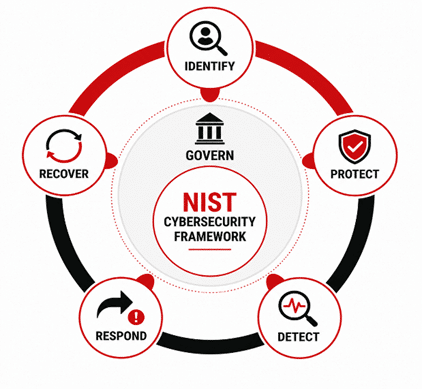
1. Govern
The “Govern” function establishes how cybersecurity risk is managed across the organization. It focuses on governance strategy, policy definition, risk oversight, roles and responsibilities, third-party risk management, and executive accountability.
2. Identify
The “Identify” function focuses on understanding organizational risk, critical assets, business systems, users, and dependencies. It includes activities such as asset management, business context analysis, and risk assessment. This stage determines which systems, users, and risks require the highest monitoring priority.
3. Protect
The “Protect” function covers safeguards designed to reduce the likelihood and impact of compromise. This includes identity and access management, endpoint protection, encryption, data security, security awareness, and preventive security controls that reduce attack surface exposure.
4. Detect
The “Detect” function focuses on continuous monitoring, anomaly identification, and threat detection across endpoints, identities, cloud environments, applications, and networks. This function forms the core of the SOC.
Without mature detection capabilities, attackers can persist within normal activity, escalate privileges, move laterally, and exfiltrate data without visibility.
5. Respond
The “Respond” function governs how incidents are analyzed, contained, coordinated, and managed after detection. It includes escalation workflows, incident handling procedures, communication processes, evidence preservation, and coordination between security and operational teams.
Effective response capability is critical to SOC operations because weak or inconsistent response processes increase containment delays, operational disruption, recovery complexity, and regulatory exposure.
6. Recover
The “Recover” function focuses on restoring systems, validating integrity, maintaining operational continuity, and improving resilience following a security incident. Activities include backup restoration, infrastructure recovery, post-incident analysis, resilience validation, and detection improvement.
Recovery capability has become increasingly important as organizations shift from traditional cybersecurity models toward broader cyber resilience strategies aligned with frameworks such as SEBI CSCRF.
NIST SP 800-53: From Policy to Detection Logic
While the NIST CSF defines the security lifecycle, NIST SP 800-53 translates that structure into detailed, enforceable security controls.
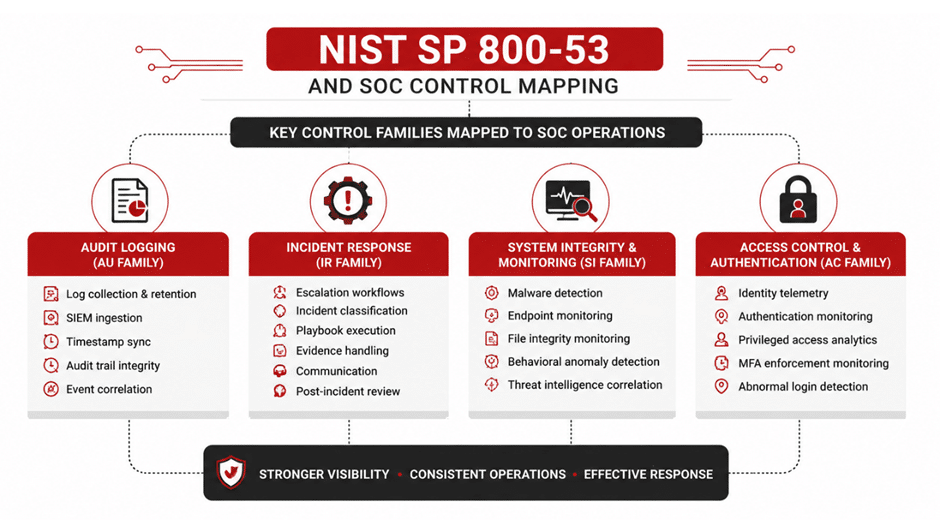
- Audit Logging and Monitoring
The Audit and Accountability (AU) controls define how security logs should be generated, retained, and reviewed. Without reliable logging, analysts cannot reconstruct attacker behavior or investigate incidents effectively.
- Incident Response Operations
The Incident Response (IR) controls define how organizations prepare for, manage, and recover from security incidents. Controls such as IR-4 (Incident Handling) and IR-5 (Incident Monitoring) ensure that incidents are managed through structured processes rather than reactive decision-making during active compromise.
- System Integrity Monitoring
The System and Information Integrity (SI) controls focus on detecting malicious activity, unauthorized changes, and system tampering. This includes monitoring for suspicious PowerShell execution, malicious process creation, unauthorized services, and endpoint integrity violations.
- Access Control and Identity (AC Controls)
These controls govern authentication, privilege management, and remote access security. As identity-driven attacks continue to increase, authentication telemetry has become one of the most critical visibility sources in enterprise security operations.
NIST SP 800-61: From Detection to Incident Response
NIST SP 800-61 Rev. 3 provides guidance for how organizations detect, analyze, contain, recover from, and learn from cybersecurity incidents. For SOC teams, it helps transform detections into structured response workflows.
1. Incident Detection and Analysis
SP 800-61 emphasizes the importance of validating alerts, determining incident severity, understanding scope, and establishing whether malicious activity is occurring. Effective analysis reduces false escalations and helps response teams prioritize resources appropriately.
2. Incident Containment
Once an incident is confirmed, organizations must limit attacker access and prevent further impact. Containment activities may include isolating endpoints, disabling compromised accounts, restricting network access, or implementing temporary controls while investigations continue.
3. Eradication and Recovery
Following containment, organizations remove malicious artifacts, remediate vulnerabilities, restore affected systems, and validate system integrity before returning to normal operations. Recovery activities are closely tied to business continuity and resilience objectives.
4. Post-incident Improvement
A key emphasis of Rev. 3 is continuous improvement. Organizations are encouraged to analyze incidents, identify control gaps, improve detection logic, refine response procedures, and strengthen resilience based on lessons learned.
Why Controls Alone Are Not Enough
Compliance frameworks establish baseline security controls, but controls alone do not guarantee effective detection capability or meaningful visibility. Enabling logs does not ensure suspicious behavior is identified, deploying endpoint protection does not guarantee visibility into lateral movement, and maintaining an incident response policy does not ensure incidents can be contained effectively.
This is where the MITRE ATT&CK framework becomes critical. Rather than focusing only on malware signatures or indicators of compromise, ATT&CK maps how real attackers behave across stages such as initial access, privilege escalation, lateral movement, persistence, and exfiltration. SOC teams use ATT&CK to align detections with real-world attacker behavior and measure how effectively those behaviors can be identified across the environment.
The next blog in this series examines MITRE ATT&CK in depth, including its structure, tactical categories, detection mapping, and how mature SOCs use it to measure and improve detection coverage.
Impact of CSCRF on SOC Design and Operations
For regulated financial entities in India, SEBI’s Cybersecurity and Cyber Resilience Framework (CSCRF) increasingly shapes SOC design, and the implications are more significant than most organizations initially anticipate. CSCRF defines the minimum cybersecurity and cyber resilience measures that regulated entities must continuously maintain.
This shifts SOC operations from capability building to continuous proof of execution. The emphasis is no longer on whether security controls exist, but whether they remain consistently active, traceable, and demonstrable under regulatory scrutiny.
Key Operational Implications
- Continuous Monitoring as a Baseline
Under CSCRF, 24×7×365 monitoring is a baseline operating condition that redefines SOC design around continuous visibility rather than periodic security review. Telemetry pipelines, analyst coverage models, and escalation processes are all aligned to ensure uninterrupted observation of systems.
- Data Localization and SOC Architecture
CSCRF places significant emphasis on data residency, record retention, and regulatory accessibility of security-related data. These requirements influence SOC architecture decisions, including SIEM deployment, log storage design, cloud region selection, and analytics pipelines.
- Third-party Systems in SOC Scope
Third-party systems are no longer treated as external risk domains but as part of the functional environment. Vendor access patterns, SaaS dependencies, cloud service behavior, and external exposure signals become relevant to SOC monitoring because they can directly impact internal security posture.
- Application and API-level Visibility
Modern financial systems rely heavily on APIs, microservices, and distributed architectures. CSCRF expectations extend SOC visibility into this layer. Monitoring is no longer limited to infrastructure-level events. It includes API authentication behavior, service-to-service communication patterns, dependency failures, and software component exposure, including SBOM-related signals. This shifts SOC analysis closer to application behavior rather than purely network or endpoint activity.
- Auditability as a Requirement
Every security event must be traceable across its full lifecycle, from detection to triage, investigation, escalation, and resolution. This requires incident workflows, analyst decisions, escalation actions, and response activity to remain consistently documented and reproducible throughout the investigation lifecycle.
- Regulatory Reporting Alignment
SOC operations under CSCRF are closely tied to external regulatory reporting obligations, including coordination with CERT-In, adherence to mandatory reporting timelines, and communication with SEBI. This creates dependency across detection speed, classification accuracy, escalation discipline, and evidence completeness. The SOC therefore functions not only as a monitoring layer but also as part of the regulatory reporting and communication chain.
Consequences of Non-compliance
Failure to comply with CSCRF and CERT-In requirements can result in regulatory penalties, supervisory scrutiny, and reputational damage. CERT-In Directions require covered entities to report specified cybersecurity incidents within six hours of noticing such incidents or being brought to notice of such incidents. Failure to meet this requirement may itself constitute non-compliance.
For SEBI-regulated entities, cybersecurity and cyber resilience obligations form part of the broader regulatory framework governing market intermediaries and regulated institutions. Where deficiencies are identified, SEBI may direct corrective actions, impose restrictions, initiate enforcement proceedings, or levy monetary penalties under the applicable provisions of the SEBI Act, 1992 and related regulations. The nature and quantum of penalties depend on factors such as the severity of the violation, its duration, the impact on investors or market integrity, and whether the entity has demonstrated adequate governance and oversight.
SOCs with weak incident management, delayed escalation, or inadequate reporting processes increase the likelihood of regulatory exposure. In the BFSI sector, unmanaged or unreported incidents can erode client trust, attract counterparty scrutiny, and increase both financial and compliance risk following a cybersecurity incident.
Measuring SOC Effectiveness
In mature SOC environments, effectiveness is not measured by the number of alerts generated or tools deployed. It is determined by how reliably the SOC detects, investigates, and contains attacker activity under real-world conditions.
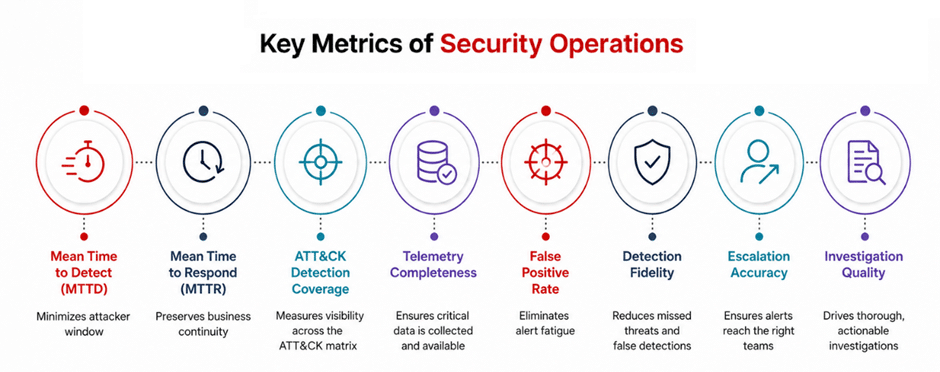
Modern SOCs therefore measure effectiveness across multiple dimensions:
| Metric | Why It Matters |
| Mean Time to Detect (MTTD) | Measures how quickly threats are identified before attackers escalate or move laterally. Lower detection times reduce attacker dwell time and limit blast radius. |
| Mean Time to Respond (MTTR) | Reflects how efficiently incidents are contained, investigated, and remediated after detection. |
| ATT&CK Detection Coverage | Measures how much observable adversary behavior is covered by existing detections across the environment. |
| Telemetry Completeness | Evaluates whether endpoint, identity, cloud, network, and application data sources provide sufficient visibility for reliable detection and investigation. |
| False Positive Rate | High false positive volumes reduce analyst efficiency, increase alert fatigue, and raise the likelihood of missed threats. |
| Detection Fidelity | Assesses whether detections generate actionable, context-rich incidents rather than low-confidence alerts. |
| Escalation Accuracy | Measures whether incidents are prioritized and routed correctly during active investigations. |
| Investigation Quality | Evaluates the SOC’s ability to reconstruct attacker activity, determine scope and impact, and maintain auditable investigation records. |
Together, these metrics provide a practical way to evaluate whether a SOC is achieving its core objective: reducing risk through timely detection, effective investigation, and decisive response.
Building Effective SOC Operations with Anzen
Frameworks such as NIST CSF 2.0 and SEBI’s CSCRF have transformed SOCs from reactive monitoring functions into structured, intelligence-driven security capabilities focused on visibility, resilience, governance, and accountability.
The challenge is turning these frameworks into consistent, measurable outcomes. Building and maintaining mature SOC functions requires specialized expertise, sustained investment, and the ability to adapt to evolving threats, technologies, and regulatory requirements. Organizations need security teams that can maintain awareness, respond effectively to threats, and support compliance requirements across the enterprise.
At Anzen, we help organizations strengthen their security posture through SOC assessments, managed SOC services, and advisory support aligned with both industry frameworks and regulatory expectations.
Whether your organization is assessing SOC maturity, identifying detection gaps, preparing for regulatory requirements, or strengthening cyber resilience, Anzen provides structured assessments and services designed for modern enterprise and regulated environments.
FAQ’s
What is the SOC framework?
A Security Operations Center (SOC) framework is a structured cybersecurity model that helps organizations identify, detect, respond to, and mitigate cyber threats. It combines technologies, processes, and practices such as threat monitoring, incident response, and vulnerability management into a unified security operation.
What is NIST and its purpose?
The National Institute of Standards and Technology (NIST) is a U.S. government agency that develops cybersecurity standards, frameworks, and best practices to help organizations improve security, manage cyber risk, and strengthen operational resilience.
Is NIST applicable in India?
Yes. Although NIST was originally developed in the United States, many organizations in India use NIST frameworks and controls to strengthen cybersecurity programs, improve detection and response capabilities, and align with globally recognized security practices.
What is CSCRF SEBI?
The Securities and Exchange Board of India Cybersecurity and Cyber Resilience Framework is a mandatory cybersecurity framework for regulated entities in India’s securities market. It establishes requirements related to security monitoring, cyber resilience, incident response, auditability, governance, and regulatory reporting.
What is the penalty for violating CSCRF?
Non-compliance may attract penalties and enforcement action under applicable provisions of the SEBI Act, 1992, and related regulations, depending on the nature, duration, and impact of the violation.
Is MITRE ATT&CK a cybersecurity framework?
MITRE ATT&CK is a publicly available knowledge base and framework that categorizes real-world attacker tactics and techniques based on observed adversary behavior.
What is MITRE ATT&CK used for?
MITRE ATT&CK is used to improve threat detection, incident response, threat hunting, and detection engineering by helping organizations understand and map attacker behavior. It enables SOC teams to measure and improve detection coverage against known attack techniques.